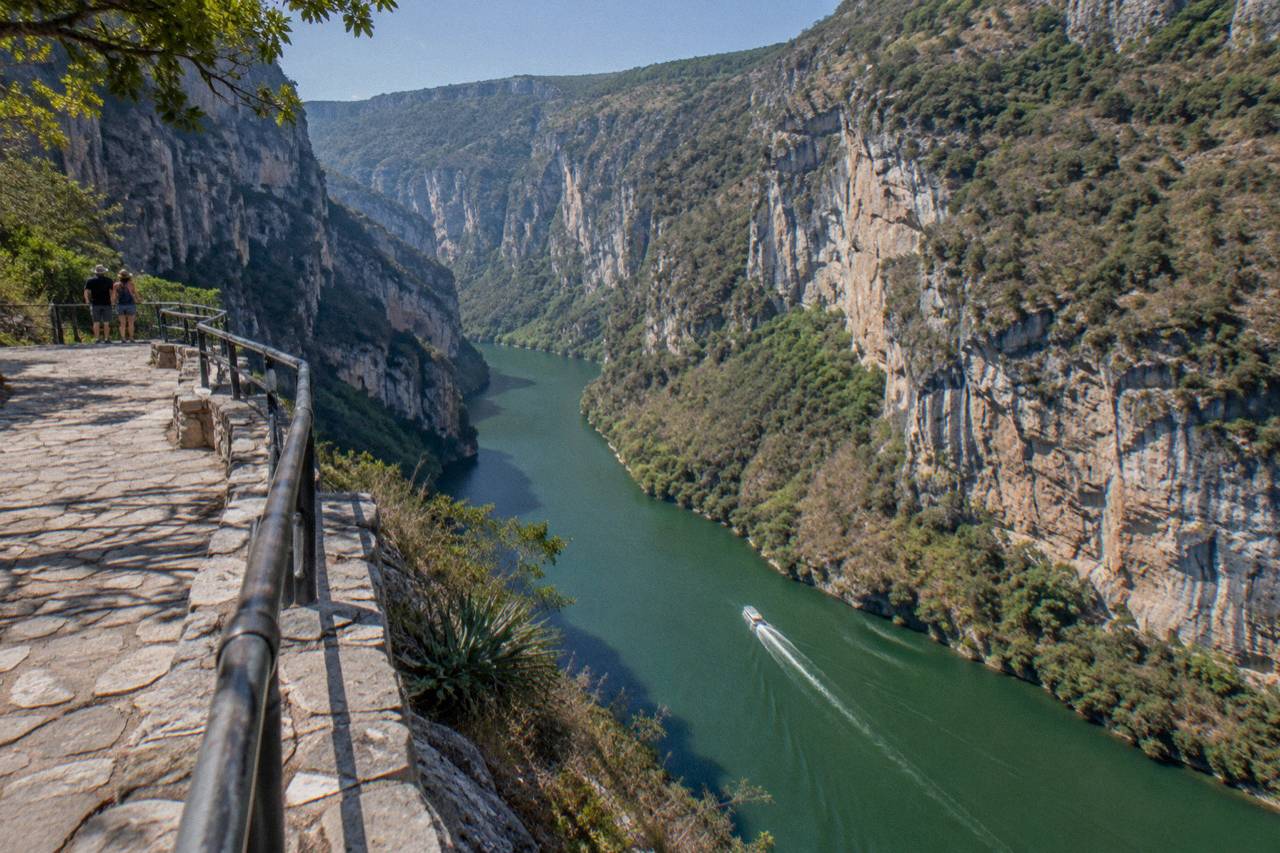
What You See On A Sumidero Canyon Boat Ride: Arbol De Navidad, Caves And Walls
The boat ride up the Grijalva River is the core of every Sumidero Canyon visit. Here is what the route actually passes, stop by stop, from the embarcadero to the dam wall and back.
Short answer
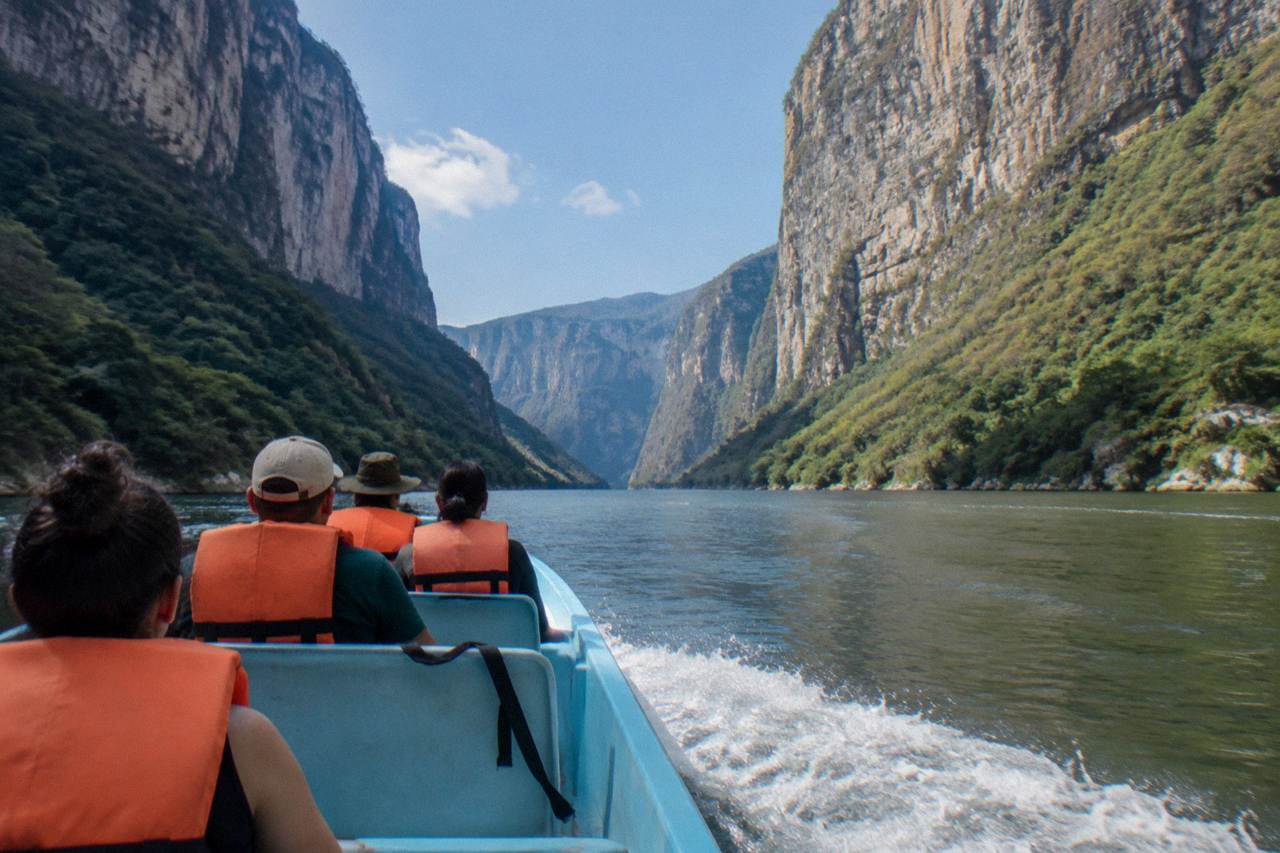
The shared lancha ride runs from the Chiapa de Corzo embarcadero up the Grijalva River to the Chicoasen dam wall and back, about two hours round trip. Named sights include the Belisario Dominguez bridge, Caballito de Mar, a river bend shaped like the Chiapas coat of arms, Cueva de Colores, Cueva del Silencio and the Arbol de Navidad waterfall.
The Grijalva River does the work here. From the embarcadero at Chiapa de Corzo, shared boats run up a canyon whose limestone walls are commonly cited at above 1,000 m, past caves, seasonal waterfalls and a dam wall at the far end, then turn around and come back. The whole thing takes about two hours on the water. That is the product at the center of nearly every listing on this site, from the budget boat days from $40 per person to the premium hotel-pickup options, and it is the reason most visitors come to Chiapa de Corzo in the first place. If you want the backstory behind what you're floating past, the background on Sumidero Canyon and its national park covers the dam, the wildlife, and how the protected area came to be.
This guide walks the route the way the boat runs it, stop by stop, with the figures as reported and the sighting claims kept to what is supported. If you are still choosing how to book the day rather than what is on it, the Sumidero Canyon Tours homepage comparison and trip picker lay out the departure cities side by side.
What Does The Sumidero Canyon Boat Ride Actually Include?
A round trip of roughly two hours on the Grijalva, from the Chiapa de Corzo embarcadero to the Chicoasen dam wall and back, in a shared boat run by a local cooperative, with a life jacket worn the whole way. The fare you pay the cooperative covers the ride; the separate 125 MXN CONANP park fee is collected independently, though most guided day tours state it is included in their price.
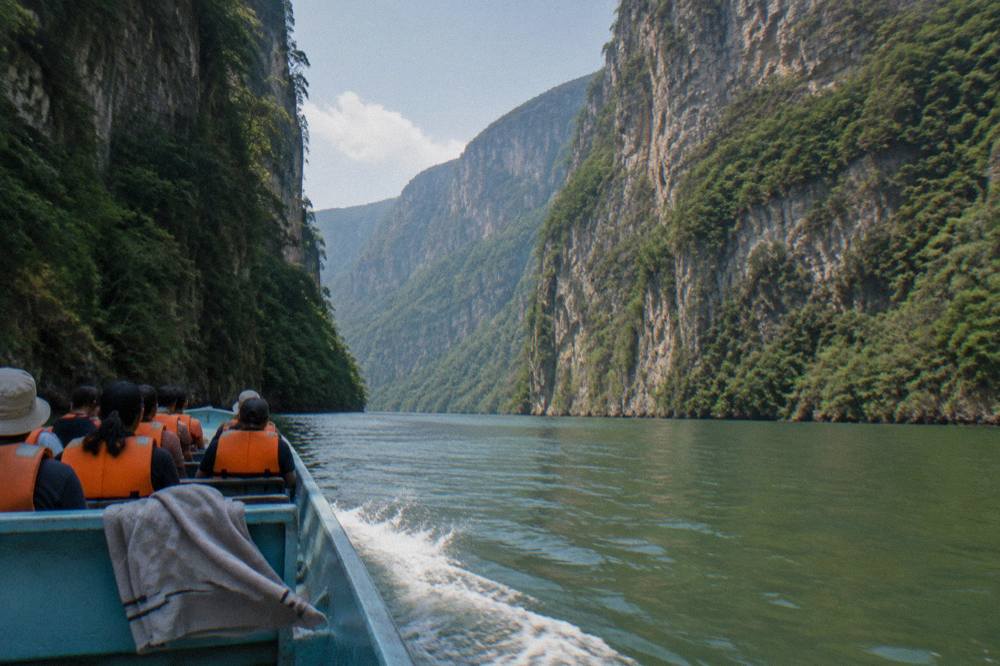
The route itself is fixed by geography, not by operator choice. There is one river, one dam at the northern end, and one cooperative dock system serving it. The route includes the Belisario Dominguez bridge, Caballito de Mar, the river bend shaped like the Chiapas coat of arms, Cueva de Colores, and the Velo de Novia and Arbol de Navidad waterfalls, ending at the wall of the Presa Manuel Moreno Torres, the Chicoasén dam, before the boat turns back. Different listings dress this differently, with a guide, a driver, a viewpoints loop or a stop in Chiapa de Corzo, but the water section is the same two hours.
That sameness is worth knowing when you compare prices. The cheapest shared boat day here runs from $40 per person, the Selva Azul budget listing with viewpoints, while the premium boat tour with hotel pickup from Selva Azul Chiapas runs from $155 per person, 4.6 from 136 reviews. What separates them is everything around the water: pickup, the vehicle, the guide, the pace. What happens between the embarcadero and the dam wall is identical in kind.
The rules on the water come from the cooperative and the park, and they are short. Life jacket mandatory, hands kept out of the water, no glass containers, no alcoholic drinks brought in, no smoking, no campfires, no pets, no drones, do not leave the boats, and wear the conservation wristband. The park's official page lists these under its visitor regulation, and the CONANP entry for the park is the primary source for both the rules and the hours.
Where Does The Canyon Boat Ride Start From?
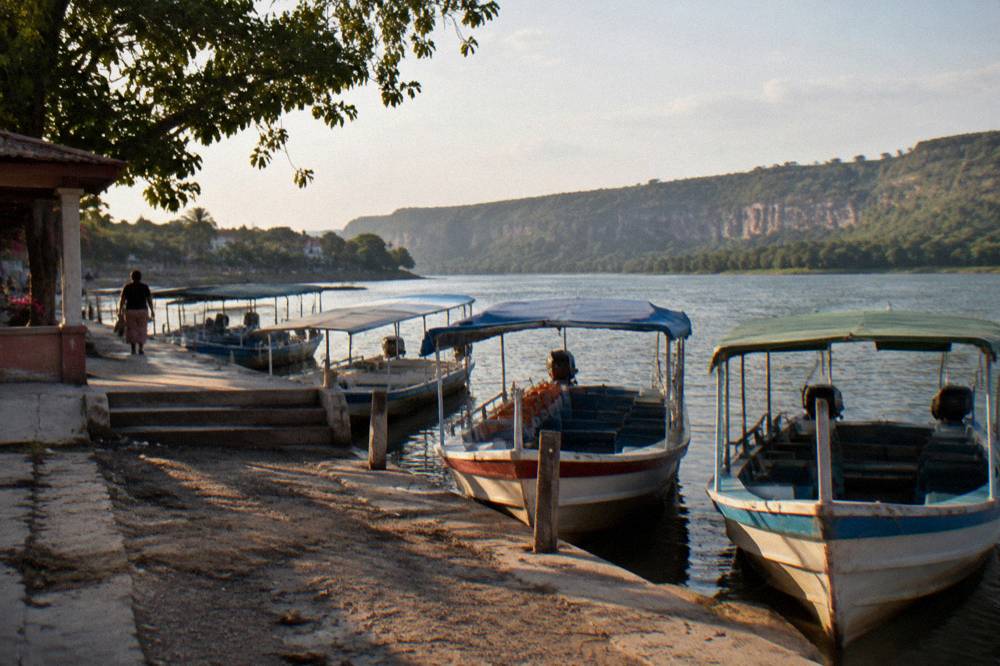
Nearly all shared rides leave from the Chiapa de Corzo embarcadero, the waterfront dock one or two blocks from the town's central park, with a second embarcadero at Cahuare on the Tuxtla highway. Boats leave when full, typically between 8:00 and 16:00, with the last full-trip departure reported around 14:00.
Chiapa de Corzo is the practical gateway. The town sits at the southern, start end of the canyon, and the dock is walkable from the plaza, which is why the standard independent plan is a colectivo from Tuxtla Gutierrez and a walk to the embarcadero. The Cahuare embarcadero, on the highway roughly at km 1078 of the Tuxtla to San Cristobal road, is the alternative, about 7 km and a few minutes' drive from Tuxtla's Libramiento Sur Oriente; its fare is reported as similar, but no primary tariff is published, so treat any Cahuare price you see online with caution. The dedicated Cahuare or Chiapa de Corzo embarcadero comparison works through that choice in detail.
If you are booking a guided day rather than arriving independently, the departure question shifts to your hotel city. Fifteen of the tours on this site leave from San Cristobal de las Casas, a reported hour or so by road from the docks, and ten leave from Tuxtla Gutierrez, which is much closer to the water. A few, like the listing that departs Tuxtla or San Cristobal, give you both. The San Cristobal departure options and the Tuxtla departure options break those tours down listing by listing.
Three days cover the spread well. These are the site's picks for this route: a San Cristobal full day, a hotel-pickup boat tour from the same city, and a Tuxtla departure for anyone sleeping in the state capital.
What Are The Main Stops On A Sumidero Canyon Boat Ride?
In order from the Chiapa de Corzo dock: the Belisario Dominguez bridge, the Caballito de Mar rock, the river bend shaped like the Chiapas coat of arms, Cueva de Colores, Cueva del Silencio, the Velo de Novia and Arbol de Navidad waterfalls, and finally the Chicoasen dam wall before the boat turns back. The boat slows or pauses at these, but nothing on the route is a guaranteed stop; conditions on the day decide.
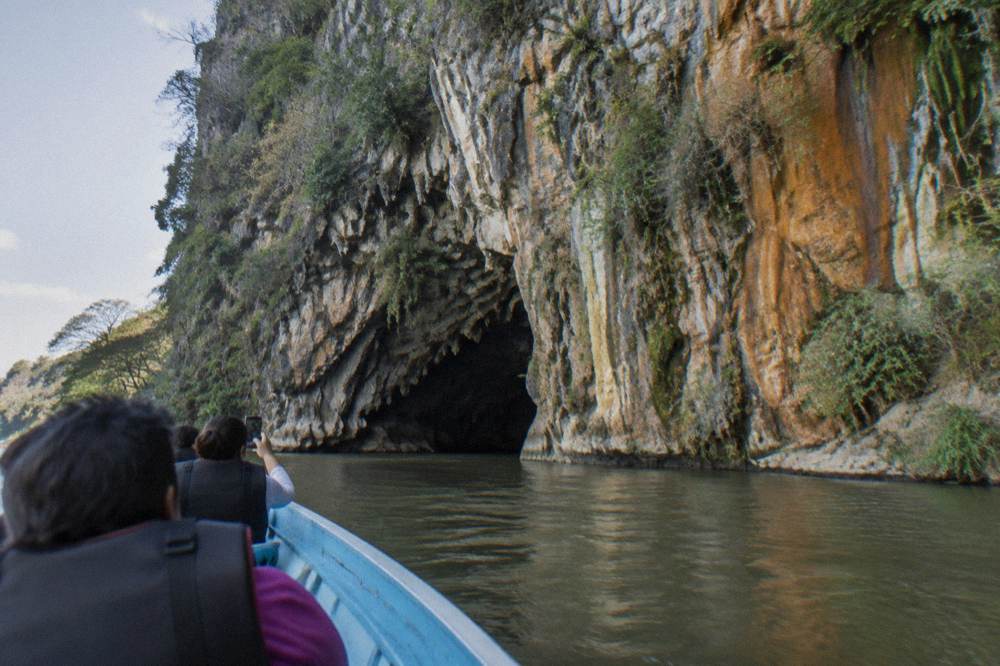
The first stretch is open river, with the canyon walls closing gradually as the boat heads north. The Belisario Dominguez bridge crosses high overhead near the start, and Caballito de Mar, a rock formation named for a seahorse, sits along the early passage. Then comes the bend that local guides point out as shaped like the Chiapas coat of arms, the two ridges supposedly echoing the crossed imagery on the state's shield. These are pass-by sights, called out by the boat captain, not landings.
| Stop or sight | What it is | How you see it |
|---|---|---|
| Belisario Dominguez bridge | High bridge crossing the Grijalva near the start | Pass under it in the first minutes |
| Caballito de Mar | Rock formation named for a seahorse | Pointed out from the boat |
| Chiapas coat of arms bend | River bend whose ridges recall the state shield | Slow pass, captain commentary |
| Cueva de Colores | Mineral-stained cave with a Virgen de Guadalupe shrine | Boat pauses at the mouth |
| Cueva del Silencio | Cave known as an echo-less chamber | Brief stop, conditions permitting |
| Velo de Novia and Arbol de Navidad | Seasonal waterfalls, the latter a moss formation shaped like a Christmas tree | Approached closely in season |
| Chicoasen dam wall | Presa Manuel Moreno Torres at the northern end | Turnaround point, longest pause |
Cueva de Colores is the emotional midpoint for many visitors. The cave's interior is streaked with mineral colors, and a shrine to the Virgen de Guadalupe stands inside, an altar that local boat crews maintain and pass by on nearly every trip. Cueva del Silencio, the cave of silence, is named for its dead acoustics. Neither involves getting off the boat; the regulation forbids leaving the boats anywhere on the route, so every sight on this list is seen from the water.
The Arbol de Navidad deserves its reputation and its caveat. The moss covered limestone formation genuinely reads as a Christmas tree, and in the rainy season the waterfall running down it can soak the front rows of the boat, while in the dry season it slows to a trickle with the structure still fully visible. Flow is seasonal and variable, so no listing, operator or article should promise you a soaking or a gush. The rainy season guide covers what changes month by month.
The turnaround is the wall of the Chicoasén dam, the Presa Manuel Moreno Torres, which closes the northern end of the canyon and holds back the reservoir that keeps this stretch navigable all year. The boat pauses at the wall, long enough for photographs of the sheer concrete against the limestone, then runs the whole route back south to the dock. About two hours, door to door on the water.
How Tall Are The Walls Of Sumidero Canyon?
The walls are commonly cited at above 1,000 m above the river, with one 2026 source giving roughly 1,200 m at the El Roblar viewpoint; those figures are cited numbers, not an official survey. The canyon runs about 30 to 33 km, and the often-quoted river depth of over 250 m is an older cited figure that no recent source re-measures.
The scale is the thing the photographs cannot convey. Standing on the boat, you are looking up a cliff face that in sections rises a vertical kilometer, limestone laid down as marine sediments in the Upper Mesozoic, roughly 80 to 136 million years ago, then cut along a tectonic fault by the Grijalva. Geology sources describe the canyon's main opening and erosion as a process on the order of twelve million years. The depth figure, over 250 m of water in the reservoir-flooded sections, circulates widely but traces to older references, so it is best read as a commonly cited legacy number rather than a fresh measurement.

| Dimension | Commonly cited figure | Status |
|---|---|---|
| Canyon length | About 30 to 33 km navigable section | Cited across recent guides |
| Wall height | Above 1,000 m, up to roughly 1,200 m at El Roblar | Cited; 1,200 m from one 2026 source |
| Width | 1 to 2 km, narrowing to around 200 m in places | Cited |
| River depth | Over 250 m | Older cited figure |
| Park area | 21,789.41 ha, decreed 8 December 1980 | Official CONANP figure |
For comparison hunters: no, this is not bigger than the Grand Canyon, and the canyon comparison piece does that math. But the viewing geometry is different. On the Grand Canyon you stand on the rim; here you stand at the bottom, in a boat, with the walls going up from you, which is why the photos from the water feel vertical in a way rim photos never do.
One way to see both perspectives in a single day is a listing that adds the viewpoints road, the miradores route above the canyon that looks down on the same walls you cruised beneath that morning. The Ecoexperiencias boat ride and viewpoints day from San Cristobal, from $79 per person with hotel pickup and a professional guide included, does exactly that loop, and it is one of the quieter ways to pair the two angles.
What Wildlife Might You See From The Boat?
American crocodiles, spider monkeys and a wide range of birds including herons, cormorants, pelicans and vultures are reported along the ride, and in October 2026 Profepa released 13 rescued river crocodiles into the park. No official population counts exist, and no sighting of any animal is guaranteed; these are what is commonly reported, not what is promised.
The crocodiles are the headline. They bask on the mud banks in the wider southern stretches, and boat captains know the spots where one is usually lying. Usually is the operative word: these are wild animals with no schedule, and crocodiles, spider monkeys and the bird life are seen on many trips, not all of them.
| Species | Where reported | Notes |
|---|---|---|
| American crocodile | Mud banks, southern stretches | 13 rescued crocodiles released by Profepa in October 2026 |
| Spider monkey | Forested wall ledges | No population count available |
| Herons and cormorants | River edge throughout | Commonly reported |
| Pelicans | Lower river near the dam | Commonly reported |
| Vultures | Thermals above the walls | Commonly reported |
Timing shapes the odds. Early morning departures are widely recommended for animal activity, calmer air and better light on the walls before the sun climbs over the rim, and the best time of day guide works through the trade-offs. Morning is also when fewer boats are on the water in high season, which changes both the noise and the photography.
Which Day Trips Pair The Boat Ride With The Viewpoints?
Most full-day listings from San Cristobal and Tuxtla combine the two-hour boat ride with a loop along the miradores road above the canyon and free time in Chiapa de Corzo, typically 8 to 9 hours door to door. Among listings with a mirador stop, those combos run from $52 per person for the Apasionado day trip with a mirador stop to $155 per person for the premium hotel-pickup boat tour. To see how all those pieces fit together in practice, the full-day Chiapas itinerary around Sumidero Canyon and Chiapa de Corzo walks you through the whole plan from pick-up to drop-off.
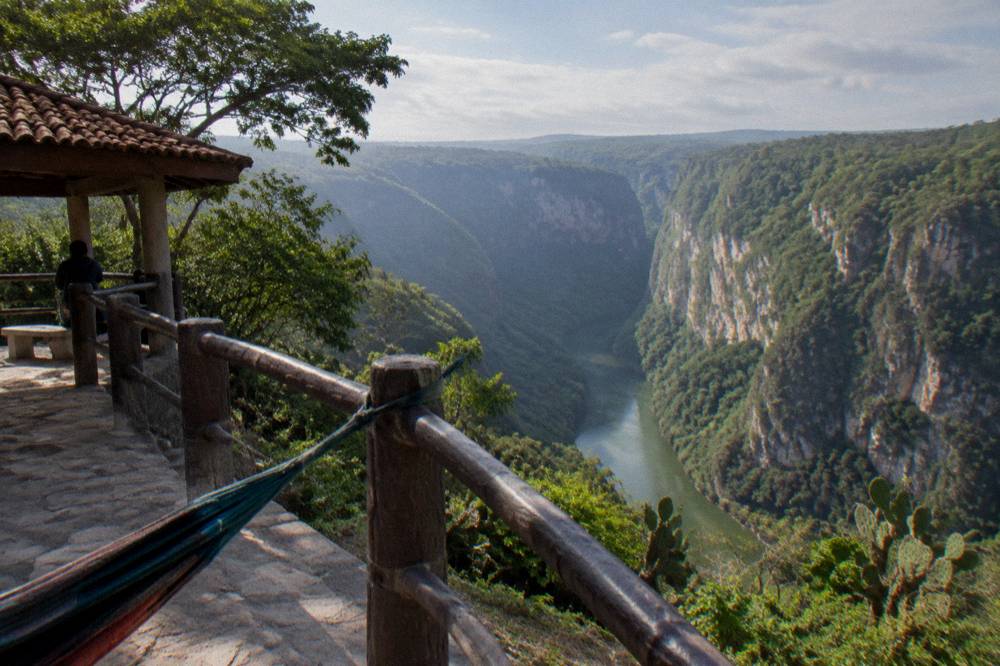
The reason the combo exists is that the two experiences answer different questions. From the water you feel the walls; from the miradores you see the canyon's whole shape, the river as a line, the scale as a landscape. The viewpoints road, reached by the Calzada al Sumidero from Tuxtla Gutierrez, carries five named lookouts: La Ceiba, La Coyota, El Roblar, Los Chiapa and El Tepehuaje. Land access is Wednesday to Monday, closed Tuesdays, while the boats run every day, a detail that catches out independent travelers who plan a Tuesday viewpoints leg.
| Listing | From | Price per person | Rating | Duration |
|---|---|---|---|---|
| OTISA budget day trip | San Cristobal | from $46 | 4.6 from 104 reviews | 9 hours |
| Apasionado day trip | San Cristobal | from $52 | 4.4 from 124 reviews | 9 hours |
| Jalapeño full day (lists Spanish and English) | San Cristobal | from $85 | 4.6 from 268 reviews | 8 to 9 hours |
| Selva Azul premium boat tour | San Cristobal | from $155 | 4.6 from 136 reviews | 8 hours |
| Apasionado Tuxtla day | Tuxtla | from $53 | 4.7 from 175 reviews | 9 to 10 hours |
| Chiapas Family Tours 5-hour | Tuxtla | from $102 | 5 from 15 reviews | 5 hours |
The Tuxtla side has its own logic. Because Tuxtla sits minutes from the docks and from the miradores road, its listings can compress the whole circuit into five hours, which is what the Chiapas Family Tours bilingual day does, 5.0 from 15 reviews, hotel pickup, a cooler of bottled water and a 2-hour shared boat tour included. For anyone flying into Tuxtla and connecting onward to San Cristobal, the Jalapeño listing that starts at the airport and finishes in San Cristobal folds the canyon into the transfer day itself.
For travelers who want to be on the water under their own power, there is also a kayak option: the double crossing kayak experience out of Tuxtla, 5.0 from 2 reviews, from $89 per person for 6 hours, park access bracelet and Chicoasen jetty entrance included. It is a different animal from the lancha, slower, lower and quieter, and with a review pool of two it should be judged as a specialist option rather than a default.
What Is The Arbol De Navidad Like Through The Year?
The Arbol de Navidad formation keeps its Christmas tree shape year round, but the waterfall running down it is seasonal: reported stronger in the rainy months of May to mid-October, sometimes soaking passing boats, and reduced to a trickle through the dry winter while the moss and limestone structure stays visible. No operator can promise flow on a given day.
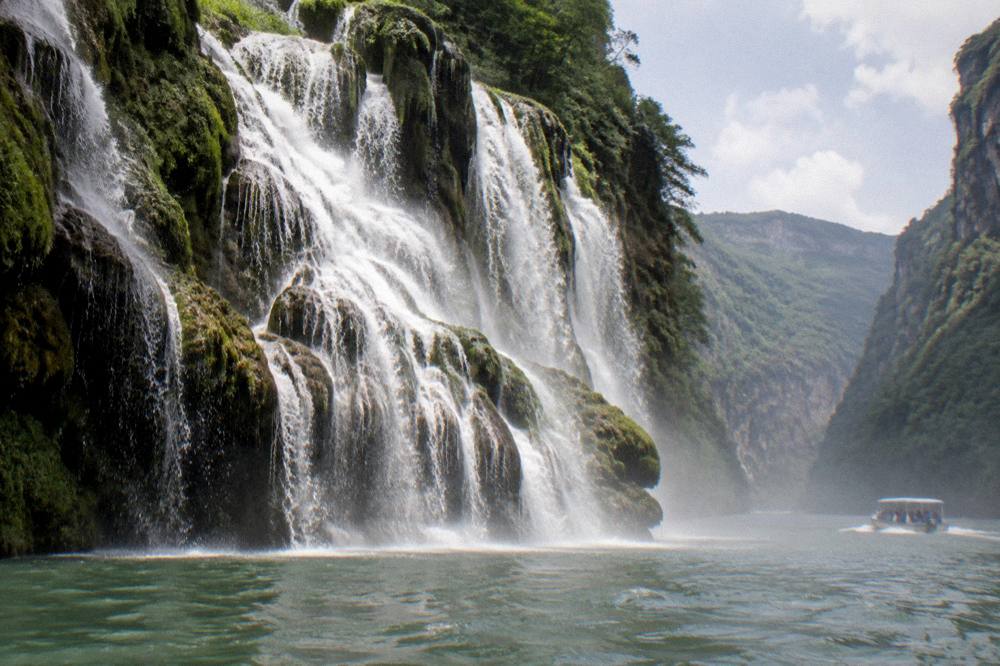
The seasonal split matters more on this route than on most, because the same rain that feeds the waterfalls also colors and moves the river. Dry season, roughly November to April, is when guides describe the Grijalva as lower and clearer, even emerald green, with the walls at their most photogenic. Rainy season brings the drama: greener walls, seasonal cascades appearing where the dry months show bare rock, and more sediment in the water after heavy rain. The best time to visit guide maps this against the climate record for Tuxtla Gutierrez, whose 1991 to 2020 normals show June averaging 211.1 mm of rain and September 208.7 mm, against 2.6 mm in December and 1.0 mm in January.
Rainy-season navigation is the caveat. Restrictions and occasional suspensions at the embarcaderos are reported when the river runs high, decided on the day by the cooperatives and the authorities, not by the tour operators. These tours run year round on paper; in practice a rainy-season booking carries a small chance of a shortened or adjusted water section. Free cancellation, which most listings here state, is the practical hedge.
How Do You Photograph The Canyon Boat Ride Well?
Sit near the front for the waterfalls and near a side for the walls, shoot in the first two hours after the morning departures when the light is still on the rock, and leave the drone at home: drones are banned on the boat ride under the cooperatives' rules. A life jacket worn the whole ride is both the rule and the reason your hands need to stay inside the boat.
The drone ban is absolute and it is the single most common confiscation risk, so the photography and drone rules guide is worth a read before you pack. On the boat itself, the practical advice is about light and geometry. The walls are lit unevenly through the day because the sun crosses the canyon rather than down it; early departures catch the walls before the contrast gets brutal, and the return leg gives you the same sights in different light. The Cueva de Colores shrine photographs well from the mouth, and the dam wall at the turnaround is the one subject where a wide lens earns its place.
Spray is the other variable. On rainy-season runs the Arbol de Navidad approach can soak the front rows, a detail 2025 and 2026 reports both repeat, so electronics live in a dry bag regardless of season. The cooperative boats are open, there is no cabin, and the ride is comfortably warm: Tuxtla's normals put afternoon highs above 29.5°C in every month of the year.
Common Questions About The Sumidero Canyon Boat Ride
What Do You See On A Sumidero Canyon Boat Ride?
The route passes the Belisario Dominguez bridge, Caballito de Mar, the river bend shaped like the Chiapas coat of arms, Cueva de Colores with its Virgen de Guadalupe shrine, Cueva del Silencio, and the Velo de Novia and Arbol de Navidad waterfalls, before pausing at the Chicoasen dam wall and returning to the Chiapa de Corzo dock. Wildlife including crocodiles, spider monkeys and herons is commonly reported but never guaranteed.
How Long Is The Boat Ride In Sumidero Canyon?
About two hours round trip, from the Chiapa de Corzo embarcadero up the Grijalva River to the Chicoasen dam wall and back. Full-day guided listings that add transport, viewpoints and Chiapa de Corzo run 8 to 9 hours door to door.
Is The Arbol De Navidad Waterfall Always Flowing?
No. The flow is seasonal: reported stronger in the rainy months of May to mid-October, when it can soak passing boats, and reduced to a trickle in the dry season, when the moss and limestone formation itself remains visible. No listing or operator can promise flow on a given day.
Does The Boat Ride Include The Park Entry Fee?
At the cooperative dock the boat fare and the 125 MXN CONANP park fee are separate charges. Guided day tours vary by listing: most, including the Jalapeño full day and the Selva Azul premium boat tour, state the park fee is included, while a few do not state it either way. Check the specific listing before booking.
Can You Get Off The Boat Inside The Canyon?
No. The park's visitor regulation forbids leaving the boats anywhere on the route, and every named sight, including the caves and waterfalls, is seen from the water.
Are The Viewpoints Included In The Boat Ride?
No, the miradores are a separate land route above the canyon, reached by road from Tuxtla Gutierrez and open Wednesday to Monday, closed Tuesdays. Many full-day listings pair the boat ride with a viewpoints loop, which is the standard way to see the canyon from both angles.