What Is The Legend Of Sumidero Canyon?
The Chiapaneca legend of the Sumidero Canyon, where the story comes from, what history records, and how the boat ride and viewpoints retell it today.
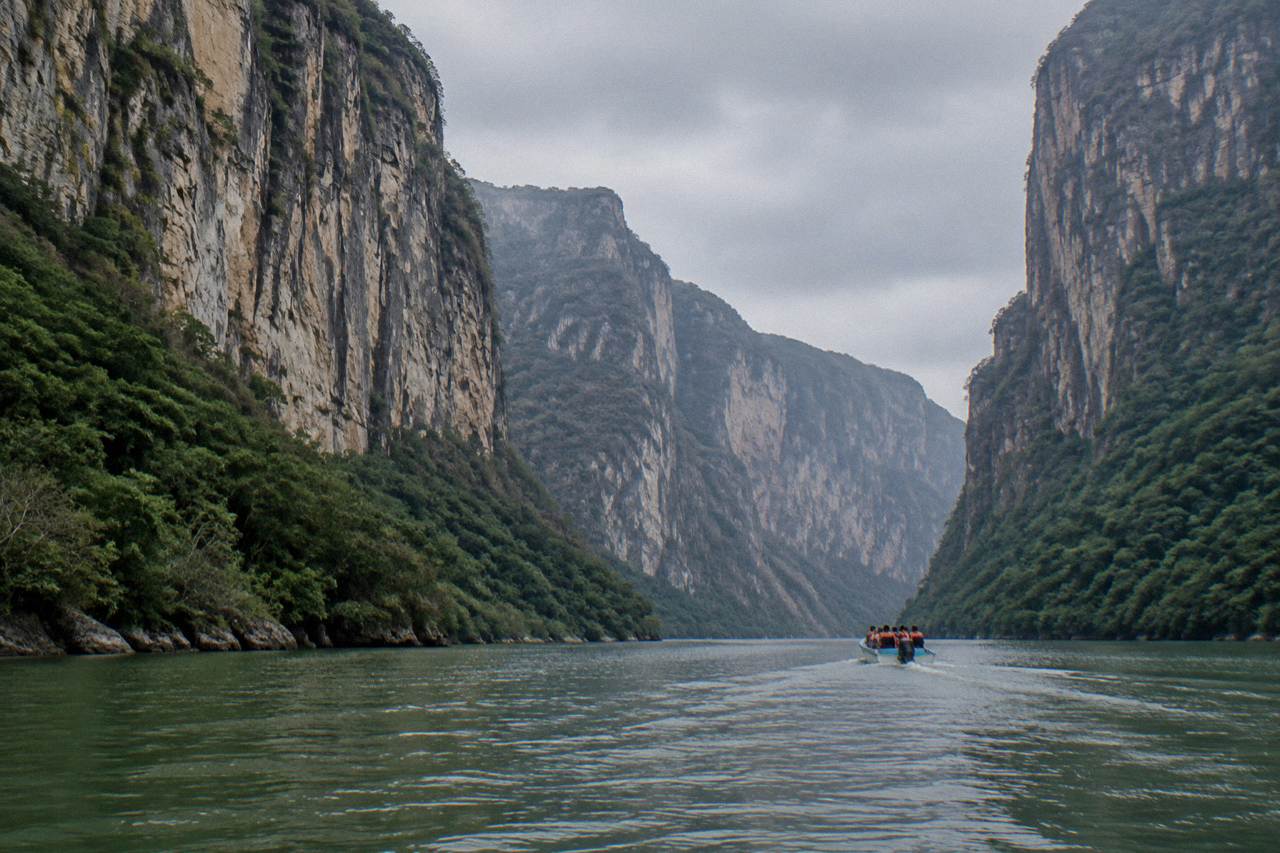
Local tradition in Chiapas tells of the Chiapaneca people who, rather than submit to Spanish forces during the conquest era, are said to have thrown themselves from the canyon walls, preferring death in the Grijalva to surrender. The story is a legend, transmitted by local tradition rather than by a contemporary written account, and this article treats it exactly that way: as a powerful piece of Chiapaneca lore that gives the canyon its emotional weight, told alongside what geology and the modern record actually establish. The rocks, for the record, are far older and stranger than any version of the story.
The canyon itself is a national park, decreed on 8 December 1980, covering 21,789.41 hectares according to the official CONANP park page. Boats run every day from the Chiapa de Corzo docks, the miradores road is open Wednesday to Monday, closed Tuesdays, and the most common way visitors experience the story today is a full day from San Cristobal: the Jalapeño canyon, viewpoints and Chiapa de Corzo tour, rated 4.6 from 268 reviews, from $85 per person, which puts the boat ride, the overlooks and the old town into one loop. Before the mechanics, the legend.
The legend says that during the Spanish conquest, as forces and their allies closed on the Chiapaneca people, a great number of Chiapaneca men, women and children threw themselves into the canyon from the high cliffs rather than be taken. In local tradition the canyon became a grave and a monument at once, the place where a people chose the void over submission. No contemporary account fixes the details, so every telling differs on numbers and circumstances.
That last sentence matters. The story of the Chiapaneca at the canyon is not a documented event with a date, a body count and named witnesses in the way a modern historian would want. It belongs to oral tradition, repeated in Chiapas for centuries.
The setting the legend uses is real enough to make any version land. The canyon runs about 30 to 33 kilometers along the Grijalva, its walls commonly cited at over 1,000 meters, with one 2026 source giving about 1,200 meters at the El Roblar viewpoint. From the rail at a mirador, the river below reads as a green thread. Standing there, the idea of people choosing the drop over conquest stops being abstract. That is precisely why the story attaches itself to this cliff face and not to some other.
Local tradition adds the detail visitors most often repeat: the canyon as a place of refusal, the "no surrender" reading of Chiapaneca identity. The name Chiapa itself, and the colonial name Chiapa de los Indios for the pre-conquest settlement on the riverbank, tie the old community directly to this stretch of water. Whatever happened during the conquest, the story has done real work since, shaping how Chiapanecos describe themselves and how the park is interpreted to visitors.
If the legend is the reason you are curious, the practical question is which day trip carries you through the same landscape the story describes. Three listings from San Cristobal cover the classic loop: the boat through the canyon, the viewpoints above it and time in Chiapa de Corzo.
Who Were The Chiapaneca And Where Does The Story Come From?
The Chiapaneca were the dominant people of the central Grijalva valley at the Spanish arrival, with their main settlement, Chiapa de los Indios, near modern Chiapa de Corzo. Their tradition holds that faced with conquest, many chose death in the canyon. The story survives through local oral tradition and later chroniclers rather than a single founding document, which is why details shift between tellings.
The Chiapaneca were not a minor group. At the Spanish arrival they controlled the crossing and the fertile valley of the Grijalva, and their town sat close to where the embarcadero stands today, a couple of blocks from Chiapa de Corzo's central plaza. The conquest of Chiapas stretched across years of campaigns and resistance, and the region took decades to subdue. Local tradition places the canyon story inside that violent first generation of contact.
The transmission of the story is its weak point and its strength. Versions collected in later centuries give different numbers of the dead and different sequences, and some tellings blend the canyon event with other episodes of resistance in the conquest of Chiapas. Historians treat the episode as a tradition with a plausible kernel, not a confirmed mass event. That is not a dismissal. Legends of this kind often preserve the memory of genuine catastrophe even when the details are beyond recovery.
What the legend reliably preserves is the meaning. For Chiapaneca descendants and for Chiapas broadly, the canyon stands for refusal, and that reading predates the national park by centuries. When the area was decreed a protected park in December 1980, it was protecting a landscape already carrying this story, walls, river, caves and all. The park's famous sights along the boat route, the Cueva de Colores with its shrine to the Virgen de Guadalupe, the Cueva del Silencio, the seasonal Árbol de Navidad waterfall, sit inside a canyon that locals read as a text.
The full-day loop from San Cristobal is the most reviewed way to stand in the story's landscape: the Jalapeño canyon, viewpoints and Chiapa de Corzo day trip, from $85 per person, rated 4.6 from 268 reviews, with the shared boat through the canyon, the miradores drive and free time in the old town. Its itinerary pairs a 110-minute canyon walk with a scenic drive through the viewpoints, then 75 minutes in Chiapa de Corzo itself, the town the Chiapaneca story belongs to.
What Does History Actually Record About The Conquest Years?
The documented record confirms prolonged conquest-era conflict around the Grijalva valley, with campaigns, enforced resettlement and repeated indigenous resistance in Chiapas. It does not contain a contemporary, detailed account of a mass death at the canyon. The leap, therefore, is in the specifics: the setting is historically charged, the exact event rests on tradition.
This split is worth stating plainly because tour commentary sometimes blurs it. The Spanish conquest of Chiapas is thoroughly documented: military entradas into the region, the founding of San Cristobal de los Españoles, decades of resistance and re-location of indigenous communities. The Chiapaneca were defeated and their world dismantled. Within that record, the canyon episode appears as tradition, retold and elaborated, not as a paragraph in a soldier's report.
Historians of Chiapas generally treat the story as plausible in context. Mass death in the face of conquest was not rare in the Americas, and the Chiapaneca had the canyon at their backs. But plausibility is not proof, and careful writing about the canyon keeps the two apart.
There is a second, quieter history layered on top: the canyon's role as a working river. The Chicoasen dam, formally Presa Manuel Moreno Torres, closes the northern end and created the reservoir that keeps the navigable stretch boat-ready all year. Recent operations have included continuous removal of floating debris and roughly 900,000 cubic meters of dredged sediment in 2025 upstream in the Chicoasen embalse, all coordinated so the two-hour tourist circuit stays open. The legend gives the canyon its meaning; the dam and the cooperatives give it its present-day function.
Visitors who want the fuller picture of the park today can go deeper with what you actually see on the boat ride, sight by sight along the route.
How Old Is The Canyon Behind The Legend?
The canyon is millions of years old, formed as the Grijalva River cut along a tectonic fault through limestone laid down as marine sediment in the Mesozoic era, roughly 80 to 136 million years ago. Some accounts place the main opening and erosion phase around 12 million years ago. The walls commonly cited above 1,000 meters are marine rock lifted and carved, and the reservoir behind the Chicoasen dam now occupies the northern end.
Geology gives the legend its stage, and the stage is genuinely ancient. The limestone walls of the Sumidero began as sediments on the floor of a Mesozoic sea. Tectonic movement cracked the crust along a fault line, and the Grijalva, one of Mexico's great rivers, exploited the crack and cut downward. The result is a gorge about 30 to 33 kilometers long, varying between 1 and 2 kilometers wide in its open stretches and pinching far narrower in places, with the navigable section running from the Chiapa de Corzo embarcadero to the dam wall and back.
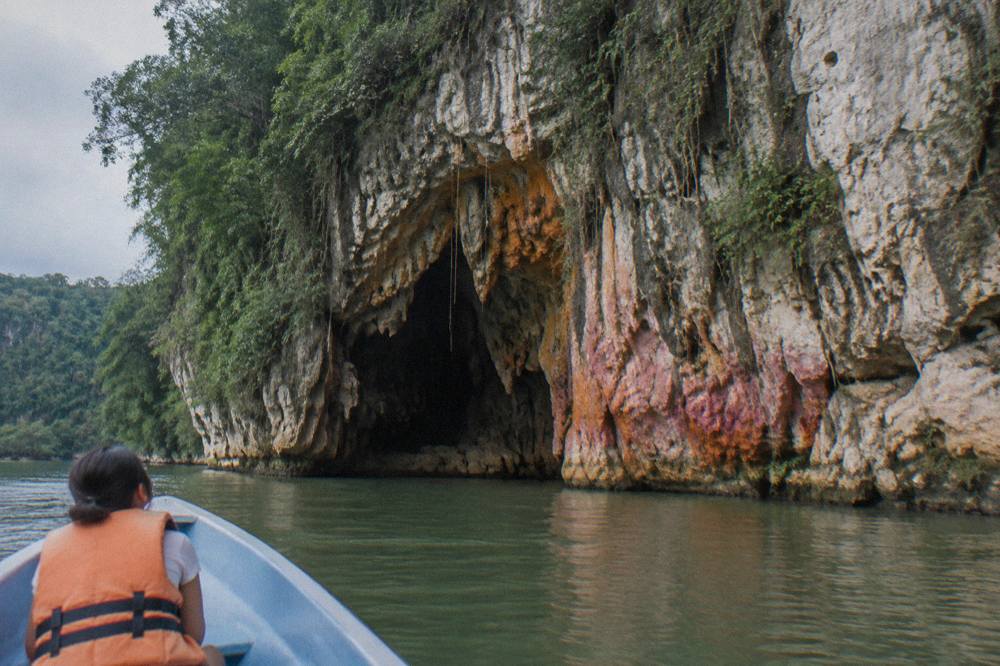
The depth figure visitors hear most often, over 250 meters of water in the reservoir, is an older, consistently cited number rather than a fresh measurement, and it is usually labelled that way. The wall height range of about 1,000 to 1,300 meters is likewise commonly cited rather than fixed by the decree. None of this softens the impression. Standing at El Roblar or La Ceiba, the number that matters is the one your eyes give you.
| Feature | Figure | Status |
|---|---|---|
| Park decree | 8 December 1980 | Official, CONANP |
| Park area | 21,789.41 hectares | Official, CONANP |
| Canyon length | About 30 to 33 km | Commonly cited |
| Wall height | Commonly above 1,000 m, one 2026 source about 1,200 m at El Roblar | Commonly cited |
| River depth | Over 250 m | Older cited figure, label as such |
| Rock age | Mesozoic marine sediments, about 80 to 136 million years | Geological sources |
| Reservoir | Chicoasen dam at the northern end | Official |
The legend compresses this deep time into a human event, which is what legends do. A canyon that took millions of years to cut becomes, in the story, the instrument of a single afternoon. Both readings coexist on every tour: the captain names caves and geological features in one breath, and the old story in the next.
What Does The Legend Look Like From The Water?
From the boat, the story attaches itself to the walls themselves: cliffs a kilometer high, the caves, the Cueva de Colores shrine, the Belisario Dominguez bridge overhead and the waterfalls. The standard ride runs about two hours from the Chiapa de Corzo embarcadero to the Chicoasen dam wall and back, and captains point out the spots local tradition has folded into the tale. The 125 MXN CONANP park fee is charged separately from the boat fare; many guided tours include it, so check each listing. Wildlife along the route, crocodiles, spider monkeys, herons and vultures, is reported but never guaranteed.
This is where the legend becomes physical. A boat leaves the dock, runs upriver under the Belisario Dominguez bridge, and within minutes the walls close in. The cooperative boats stop at the named features: Caballito de Mar, the river bend shaped like the Chiapas coat of arms, the Cueva de Colores with its mineral stains and its altar to the Virgen de Guadalupe, the Cueva del Silencio, and the seasonal waterfalls including the Árbol de Navidad, which flows hardest in the rainy season and shrinks to a trickle in the dry months while the moss structure stays visible. More of these guides are collected on Sumidero Canyon Tours.
Rules on the water are strict and simple: life jacket mandatory, hands out of the water, no glass, no alcohol, no drones, no pets, do not leave the boat, and wear the conservation wristband. The park entry fee is 125 MXN per person per day, separate from the boat fare, which in 2026 runs 460 MXN for foreign visitors, 400 MXN for Mexican nationals, 340 MXN for older adults with INAPAM credential and children, and 290 MXN for children under 2. Fares are set by the boat cooperatives and can change without notice.
Wildlife is part of the route's pull. American crocodiles, spider monkeys and birds including herons, cormorants, pelicans and vultures are reported along the ride, with no official population counts. In October 2026 Profepa released 13 rescued river crocodiles into the park, animals taken from urban areas between 2022 and 2025. No sighting is promised on any trip, and any listing that implies one is overpromising.
For readers tracing the story on a budget, the OTISA budget fare from San Cristobal, from $46 per person for a 9-hour day, runs the river boat for 100 minutes plus free time in Chiapa de Corzo, rated 4.6 from 104 reviews. It is the plainest version of the loop: transport, entrance fees, the boat and the town, with the guide listed as excluded.
To go deeper on the animals and where the ride actually finds them, see the canyon wildlife guide, which keeps the same rule: what is reported, not what is counted or promised.
How Do The Viewpoints Retell The Story?
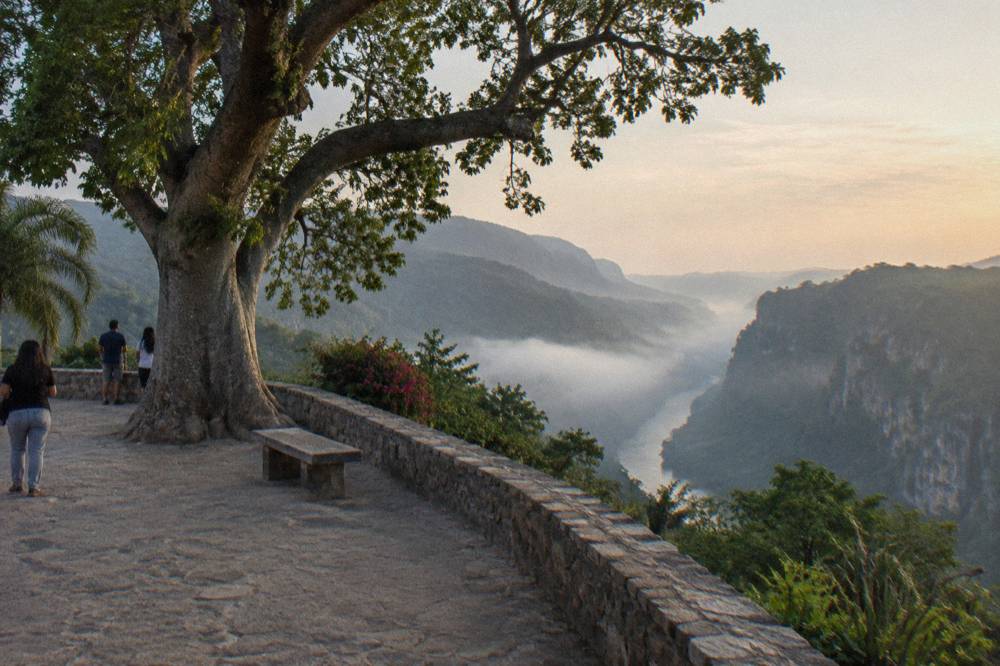
The five miradores above the canyon, La Ceiba, La Coyota, El Roblar, Los Chiapa and El Tepehuaje, are where the legend lands hardest, because from the rail the drop is visible and total. The road is open Wednesday to Monday, 8:00 to 17:00, closed Tuesdays, under the same 125 MXN park fee. Most San Cristobal day tours build the viewpoints into the return leg, pairing the water-level view with the cliff-top one.
The miradores road, the Calzada al Sumidero from Tuxtla Gutierrez, strings the five overlooks along the rim. El Roblar is the one most often named for the tallest perspective. From up there the Grijalva is a green line, the boats are specks, and the vertical scale that the legend turns into narrative becomes simple fact. Visitors who ride the canyon in the morning and stand above it in the afternoon get the story twice, once from inside and once from above.
Not every tour includes the viewpoints, so check the listing before booking. The Jalapeño full day from San Cristobal pairs its canyon walk with a 45-minute scenic drive through the viewpoints, and the OTISA 9-hour tour with viewpoints from $86 per person, rated 4.6 from 44 reviews, runs the boat and then the miradores in a similar order, capped at 30 travelers. The Jalapeño miradores day trip from $56 per person, rated 4.5 from 85 reviews, covers the overlooks and the park with a Spanish-speaking operator.
The one scheduling trap is Tuesdays. Water access runs every day, but the land road to the miradores is closed, so a Tuesday visit from San Cristobal means a boat-only day unless the operator reroutes. The park hours, 8:00 to 17:00 for both accesses, come from the official CONANP page.
There is also a slower, quieter way to be inside the walls: the double crossing kayak experience from Tuxtla, from $89 per person for 6 hours, rated 5 from 2 reviews, which includes park access and the Chicoasen jetty fee. Six hours of paddling the same water the boats cross in two gives the canyon a different register entirely.
When Should You Visit The Canyon Of The Legend?
The dry season, roughly November to April, is the window most sources recommend: lower river, clearer water, stable weather and better visibility from both boat and rim. The rainy season, May to mid-October with peaks in June and September, brings higher flow, greener walls and stronger waterfalls, but also possible navigation restrictions. Boats run all year; the miradores road simply needs a non-Tuesday.
The climate record for Tuxtla Gutierrez, from the CONAGUA 1991 to 2020 normals for the city's station, shows why the seasons split so cleanly. Rainfall is negligible from November through March, jumps in April, and then runs heavy from May through October. Temperatures peak in April and May, with normal daily maxima of 35.9 and 35.4 degrees Celsius, and ease back toward 29.5 degrees in the coolest months.
| Month | Normal max temp (C) | Rainfall (mm) | Rain days |
|---|---|---|---|
| January | 29.5 | 1 | 0.8 |
| February | 31.8 | 1.8 | 0.5 |
| March | 33.9 | 2.6 | 0.6 |
| April | 35.9 | 9.7 | 1.9 |
| May | 35.4 | 88.5 | 9.1 |
| June | 32.8 | 211.1 | 17.7 |
| July | 32.4 | 164.5 | 16.6 |
| August | 32.4 | 216.6 | 16.7 |
| September | 31.6 | 208.7 | 18.4 |
| October | 30.7 | 77 | 10 |
| November | 29.6 | 16.7 | 3 |
| December | 29.5 | 2.6 | 1.2 |
The official rainy season, per the national meteorological service, runs May to mid-October with peaks in June and September, and hurricane season overlaps it: the Atlantic basin from 1 June to 30 November and the Eastern Pacific from 15 May to 30 November, dates from NOAA's tropical cyclone climatology page. Rainy-season navigation restrictions at the embarcaderos are reported in 2025 and 2026 sources, so summer visitors should accept that a high-water day can mean a rerouted or suspended ride, and never count on waterfall flow.
Early morning is the best window on any day: reports and operator guidance favor departures before about 9:00 for light on the walls, calmer air and more animal activity, and the docks run trips from 8:00 until late afternoon. The dry-season months are also the busy ones, so an early start doubles as crowd management.
For planning around water levels and months, the best time to visit the canyon guide carries the full seasonal breakdown, and the rainy-season guide covers what changes when the river rises.
Which Day Trip Fits The Story You Want?
Pick by what part of the legend you want to stand inside: the water-level version is the shared boat day from San Cristobal or Tuxtla, the cliff-top version needs a viewpoints itinerary, and the private or kayak formats put you alone with the walls. Prices run from $40 per person on the cheapest shared boat day up to $155 per person on the premium boat day.
| Listing | Operator | Price | Rating | Duration | Viewpoints |
|---|---|---|---|---|---|
| Canyon, Viewpoints and Chiapa de Corzo day | Jalapeño | From $85 per person | 4.6 from 268 reviews | 8 to 9 hours | Yes, scenic drive |
| Miradores day trip | Jalapeno Tours | From $56 per person | 4.5 from 85 reviews | 8 hours | Yes, with park visit |
| Premium boat tour, hotel pickup | Selva Azul Chiapas | From $155 per person | 4.6 from 136 reviews | 8 hours | Yes, mirador photo stop |
| Budget fare day trip | OTISA VIAJES | From $46 per person | 4.6 from 104 reviews | 9 hours | No, boat and town |
| Tuxtla views and Chiapa day | Apasionado x Chiapas | From $53 per person | 4.7 from 175 reviews | 9 to 10 hours | Yes, mirador stop |
The differences are real. The premium Selva Azul day includes hotel pickup and drop-off, a 90-minute boat tour, the park entrance fee and travel insurance, from $155 per person, with an English-speaking guide on the private option only. The Apasionado day from Tuxtla, the best-rated listing on these tours at 4.7 from 175 reviews, spends three hours in the canyon area plus a two-hour mirador stop, and will drop you in either Tuxtla or San Cristobal. The budget OTISA fare strips the day to transport, entrance fees, the boat and town time, with the guide excluded, which suits confident travelers and tight budgets.
Cancellation policies are listed as free on most of these, but not on all: the Ecoexperiencias boat ride and viewpoints day does not state free cancellation, so read the live listing before booking. Meal arrangements are thin across these tours; most listings exclude food, and only a handful, like the Tuxtla viewpoints-and-cruise day with its buffet dinner, include a meal line. Neither detail changes the legend, but either can change a day.
Common Questions About The Sumidero Canyon Legend
What Happened To The Chiapaneca People At The Canyon?
Local tradition says that during the Spanish conquest, facing Spanish forces and their allies, Chiapaneca men, women and children threw themselves from the canyon's cliffs into the Grijalva rather than surrender. The story is transmitted by local tradition, not by a contemporary written record, and details vary between tellings. It remains the emotional core of how Chiapas interprets the canyon.
Is The Chiapaneca Story Historically True?
The conquest-era conflict around the Grijalva valley is thoroughly documented, but the specific mass event at the canyon rests on oral tradition and later retellings rather than a contemporary account. Historians treat it as a plausible legend with a real historical backdrop, not a confirmed incident with fixed numbers.
Where Does The Boat Ride Connect To The Legend?
The standard two-hour ride from the Chiapa de Corzo embarcadero to the Chicoasen dam wall passes the cliffs, caves and features, including the Cueva de Colores shrine, that local tradition folds into the story. Captains commonly narrate the legend alongside the geology and wildlife.
How Old Is The Canyon Compared To The Legend?
The canyon's limestone walls are Mesozoic marine sediments, roughly 80 to 136 million years old, carved by the Grijalva along a tectonic fault, with some accounts placing the main erosion phase around 12 million years ago. The conquest-era legend is, by comparison, a very recent chapter.
Can You See The Canyon Walls From The Viewpoints On Any Tour Day?
The miradores road is open Wednesday to Monday from 8:00 to 17:00 and closed on Tuesdays. Many San Cristobal day tours include a viewpoints drive; check the listing's itinerary, since budget fares may cover only the boat and Chiapa de Corzo.