What Is Chiapas, Mexico Famous For?
Chiapas is famous for Sumidero Canyon, the Maya ruins of Palenque, the waterfalls of Agua Azul, the colonial town of San Cristobal de las Casas, and its amber and textile traditions. Here is what each one is, and how travelers actually see them.
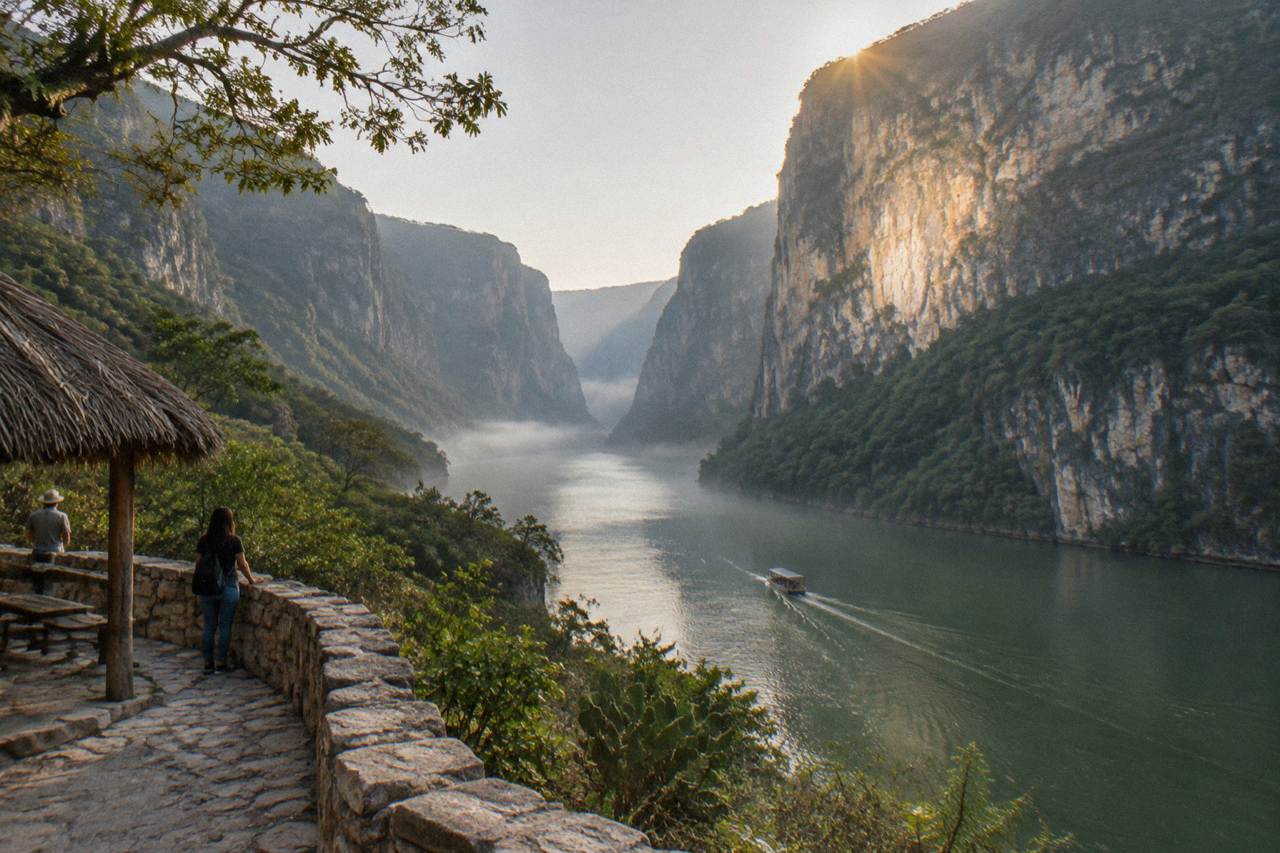
Chiapas sits at the southern edge of Mexico, and its reputation rests on a short list of sights that punch far above the state's size. The two-hour boat ride through a limestone gorge, a Maya city in the jungle, blue waterfalls, a cold highland town full of churches and weavers, and a resin that turns into orange jewelry. Travelers usually come for one of these and leave having seen three or four, because the distances between them are short enough to chain together on a multi-day loop. If you're wondering how long that loop needs, the guide to planning your days in Chiapas lays out what fits into each itinerary length.
The practical entry point for almost all of it is Tuxtla Gutierrez, the state capital, or San Cristobal de las Casas in the highlands an hour up the road. The canyon is the closest big sight to both, which is why so many itineraries open with it and why this site exists. The Jalapeño full day from San Cristobal covers the boat ride, the viewpoints and Chiapa de Corzo in a single 8 to 9 hour outing, and the multi-day packages that add Palenque and the waterfalls all build on that same first day.
The state has a second, quieter fame among Mexican travelers: it is one of the country's most biodiverse regions, stretching from Pacific coastal wetlands through cloud forest to rainforest, and it produces most of Mexico's hydroelectric power from dams on the Grijalva, including the Chicoasen structure that closes the northern end of the canyon itself. That mix, heavy nature plus living Maya culture plus colonial architecture, is what defines Chiapas, a state where Indigenous heritage shapes daily life as much as the landscape does. Roughly a quarter to a third of its population identifies as Indigenous depending on the survey, and that shows up everywhere in the markets, the languages on the buses and the festivals.
Chiapas is famous for five things: Sumidero Canyon, the boat gorge an hour from San Cristobal; the Maya ruins of Palenque; the blue cascades of Agua Azul and Misol Ha; the colonial highland city of San Cristobal de las Casas; and its amber, textiles and indigenous communities such as San Juan Chamula and Zinacantan. Most first visits combine the canyon with at least two of the others.
That list is not a ranking, but geography gives the canyon the lead. Palenque lies in the far northeast of the state, Agua Azul on the road toward it, San Cristobal in the central highlands, and the canyon on the Grijalva River just northeast of the capital, Tuxtla Gutierrez. A loop that starts in Tuxtla, rides the canyon, climbs to San Cristobal, then swings north to the waterfalls and Palenque, is the shape of most packaged tours and most independent trips alike. The 4-day Palenque tour and the 5-day "Unforgettable Chiapas" itinerary sold on this site follow exactly that arc, which says something about how settled the route is.
The state's fame also rests on things you cannot book a ticket for. Chiapas produces most of Mexico's amber, mined around Simojovel and sold in every silver-and-amber shop in San Cristobal. Its weavers, particularly in Zinacantan and Magdalenas Aldama, make some of the most respected backstrap-loom textiles in the country. And its indigenous communities, Maya Tzotzil and Tzeltal among them, give the highlands a cultural depth that the beach states simply do not have. A trip that only touches the canyon misses the half of the answer.
Coffee belongs on the list too. The Sierra Madre slopes toward the Pacific grow some of Mexico's most sought-after beans, and cafe culture in San Cristobal is one of the town's quiet attractions, with roasters pouring highland-grown cups a short walk from the zocalo. Then there is the food angle: Chiapas cooking leans on its own cheeses, its chipilin herb in tamales and soups, and the cochito pork of the central valleys. None of it is as internationally famous as Oaxacan or Yucatecan cuisine, which is part of the appeal; you are tasting things the guidebooks have not fully standardized yet.
Why Is Sumidero Canyon The State's Signature Sight?
Sumidero Canyon is the famous one because it is dramatic, accessible and close: a gorge about 30 to 33 km long with walls commonly cited above 1,000 m, a two-hour shared boat ride up the Grijalva River to the Chicoasen dam wall and back, and departure docks about an hour by road from San Cristobal. No other Chiapas sight combines that scale with that ease.
The numbers explain the fame. The national park, decreed on 8 December 1980, covers 21,789.41 hectares, and the limestone walls are Mesozoic marine sediments eroded along a tectonic fault, which is why they rise so sheer from the water. One 2026 source puts the maximum wall at about 1,200 m near the El Roblar viewpoint. The river below is famously deep; a figure of over 250 m circulates widely but comes from older citations, so treat it as a commonly quoted figure rather than a fresh survey. The official CONANP park page is the primary source for the park's area, hours and fee.
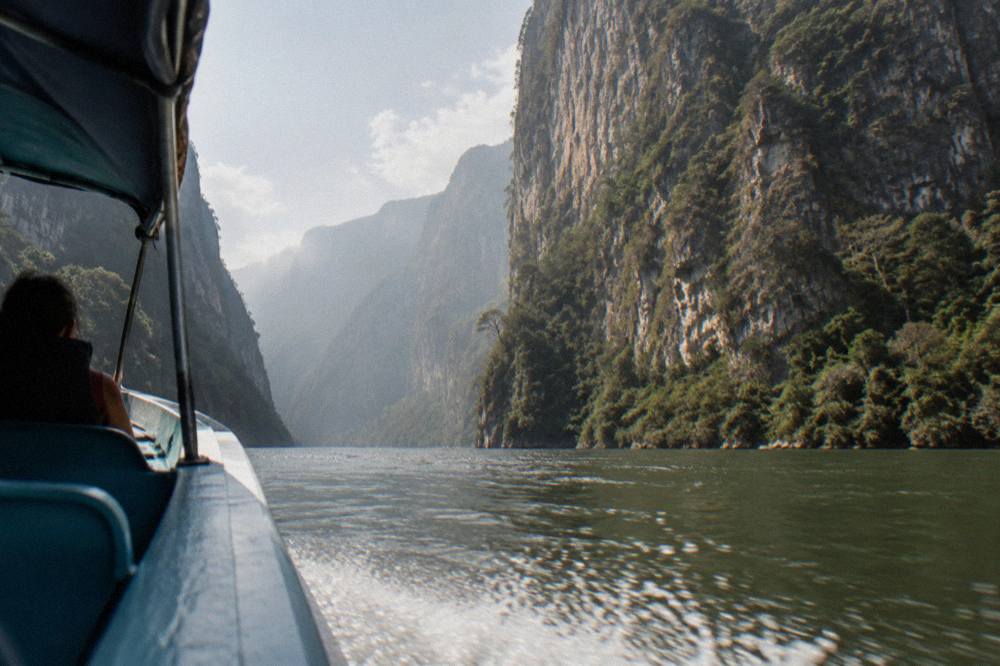
The ride itself is the product most visitors buy. Boats leave the Chiapa de Corzo embarcadero, run past the Belisario Dominguez bridge, caves with mineral-stained walls and a shrine to the Virgen de Guadalupe, seasonal waterfalls such as the Arbol de Navidad, and turn around at the dam wall. Crocodiles, spider monkeys and herons are reported along the route; no operator can promise a sighting, and the listings here do not try. Among the tours on this site, the Jalapeño full day from San Cristobal, 4.6 from 268 reviews, the most reviewed listing on this site, is the standard version of that day, from $85 per person with transport, entrance and park fees, and the shared boat included. Food and a guide are extras on that listing, which is worth knowing before you compare it against the premium Selva Azul boat day at from $155 per person with hotel pickup.
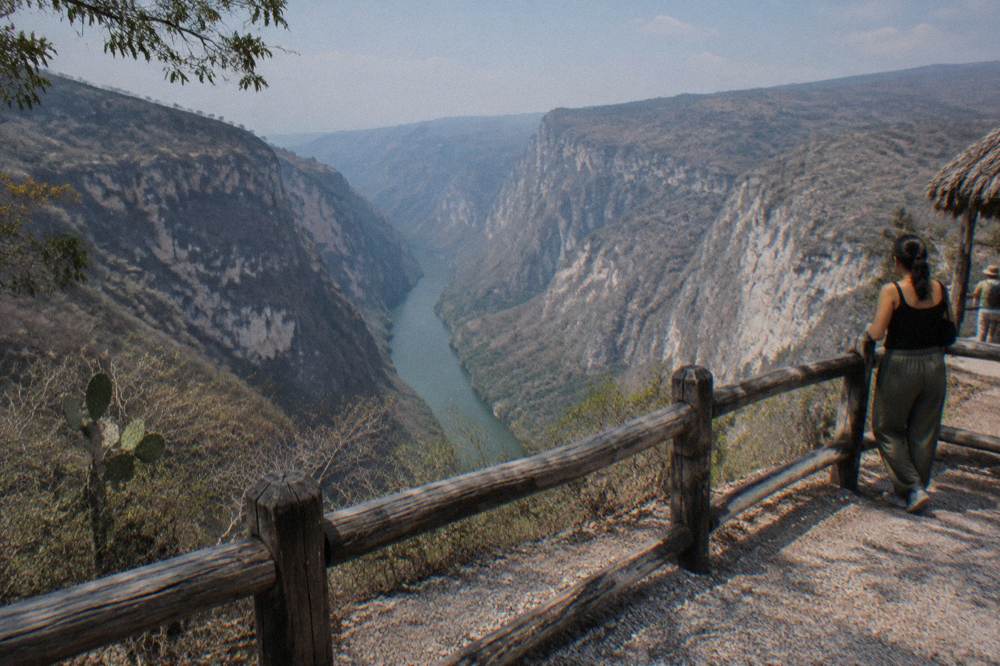
Most canyon days also stop at Chiapa de Corzo, the small colonial town at the dock, and several add the viewpoints road above the gorge. The viewpoints are closed to land traffic on Tuesdays, a detail that catches out a lot of independent travelers; boat access runs every day. The entrance fee is 125 MXN per person per day, separate from the cooperative boat fare, and many guided tours state the park fee as included, so the listing you choose changes what you pay at the gate.
What Is Palenque, And Why Do Travelers Add It?
Palenque is a Maya archaeological site in the jungle of northeastern Chiapas, famous for its palace, its inscriptions and its setting among ceiba trees and howler monkeys. It is the state's biggest name after the canyon, roughly a half-day drive from San Cristobal, which is why multi-day packages pair the two rather than asking visitors to choose.
Qualitatively, Palenque is what people picture when they hear "Maya ruins": stone temples on terraces, a tall observation tower on the palace, and tombs, including the one whose occupant's carved sarcophagus lid became one of the most reproduced images of Maya art. The site sits inside a national park of rainforest, and its museums hold pieces found in the excavations. The description stays at that level because the site's entry prices are not listed here; if you go, check current admission on official channels.
The practical link for canyon visitors is the road. From San Cristobal, the route north passes the Agua Azul waterfalls and Misol Ha, then reaches Palenque, which is why the From Tuxtla Gutierrez: Palenque and Chiapas 4-Day Tour sells so naturally as a follow-on to a canyon day. That package, from $1,037 per person for the multi-day package, includes the boat ride in the canyon, entrance fees to all sites, 4-star hotels in San Cristobal and Palenque, breakfasts, a lunch on day three, and a Spanish-certified driver, with a stated maximum of 15 travelers. It carries no rating yet, so there is no review pool to report. The longer 5-day "Unforgettable Chiapas" version, from $1,130 per person for the package, rated 4.4 from 2 reviews, adds a night in Tuxtla and reaches Villahermosa.
Flights matter for how people actually reach it. The Tuxtla Gutierrez airport has multiple daily direct flights to Mexico City on Aeromexico, Volaris and VivaAerobus, and Palenque's small airport receives a Mexicana route from Mexico City Santa Lucia about three times weekly, with no direct United States routes at either field listed for 2026. In practice that means almost everyone enters through Mexico City, lands in Tuxtla, does the canyon first, and works north.
What About San Cristobal, Amber And The Textiles?
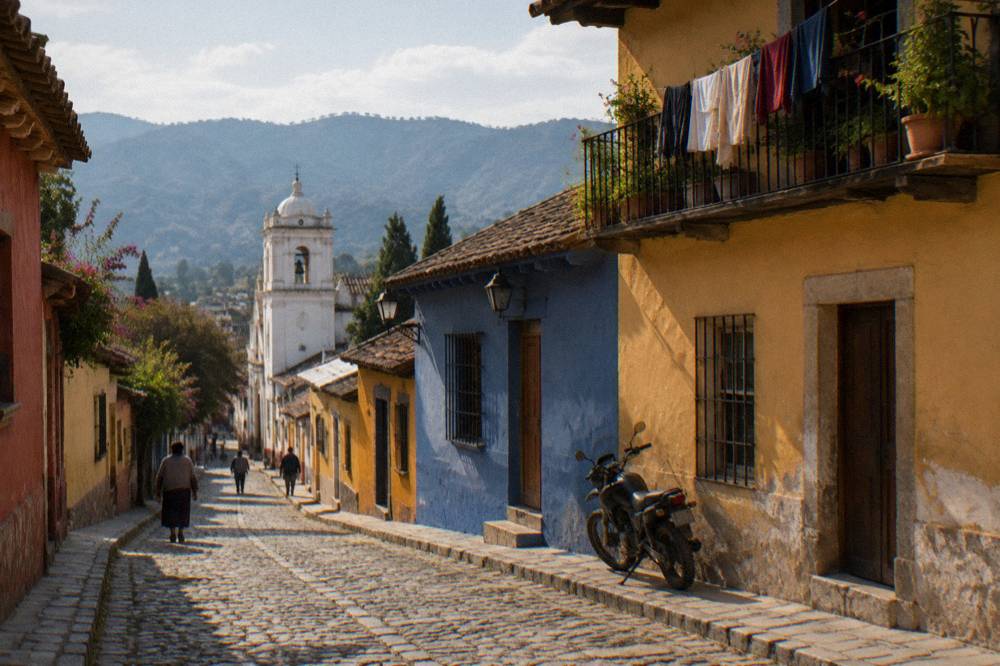
San Cristobal de las Casas is the famous highland town: a colonial core of tiled roofs and church towers high in the mountains, surrounded by Tzotzil and Tzeltal villages known for weaving and amber. It is the standard base for canyon day trips and the place where most visitors actually buy the crafts Chiapas is known for.
Its plazas, stair-street churches such as Guadalupe and San Cristobal, and the Santo Domingo artisan market are the postcard. Amber, fossilized resin mined in the Chiapas highlands, is the state gem and fills the jewelers' shops. Textiles from Zinacantan, heavy embroidered huipils and tablecloths, arrive in the same markets. The free-and-cheap angle matters here too: several genuinely free sights in both San Cristobal and Chiapa de Corzo, from the La Pila fountain to the INAH textile museum, are covered in our guide to free things to do in San Cristobal and Chiapa de Corzo.
For canyon logistics, San Cristobal works because the departure meeting points cluster downtown, at Portal 9 by the central park, and the drive to the docks takes about an hour by road. The budget end reflects that: the OTISA 9-hour day trip from San Cristobal runs from $46 per person, 4.6 from 104 reviews, transport, entrance fees and the shared boat included, guide and food extra. At the other end, the EcoExperiencias bilingual day from $135 per person adds an English-language structure that the Spanish-only budget fares do not carry. If you are still deciding where to sleep, the guide to where to stay near Sumidero Canyon breaks down the town-versus-capital trade.
A subtler part of the fame is the indigenous communities themselves. San Juan Chamula, with its remarkable church where traditional practice and Catholicism blend, and Zinacantan, with its weaving cooperatives, sit half an hour from San Cristobal, and several tours on this site visit them. The Tuxtla combo that pairs the canyon boat ride with Chamula and Zinacantan and finishes in San Cristobal, from $145 per person and rated 5 from 6 reviews, is one way to compress the cultural half of the answer into a single day. The US State Department's Mexico advisory currently lists Chiapas at Level 3, Reconsider Travel, with no additional restrictions named for Tuxtla, Chiapa de Corzo or San Cristobal; read it yourself before deciding.
Which Multi-Day Package Covers The Famous Sights?
The packages that cover the famous sights are the 3, 4 and 5-day Chiapas circuits on this site: the 3-day from $567 per person, the 4-day Palenque circuit from $1,037 per person, and the 5-day from $1,130 per person. All three include the canyon boat ride and 4-star hotel nights; the longer two add the waterfalls and Palenque.
Here is how the three compare:
| Package | Price basis | Nights | Canyon boat | Other big sights | Meals stated | Rating |
|---|---|---|---|---|---|---|
| Chiapas 3-Day and 2-Night Package | from $567 per person (multi-day package) | 2 in San Cristobal, 4-star | Shared boat included | Chiflon and Montebello lakes, Chamula and Zinacantan, viewpoints | 2 American breakfasts | No rating yet |
| Palenque and Chiapas 4-Day Tour | from $1,037 per person (multi-day package) | 2 San Cristobal, 1 Palenque, 4-star | Boat ride included | Palenque ruins, entrance fees to all sites | Breakfasts plus lunch on day 3 | No rating yet |
| Unforgettable Chiapas 5-Day Tour | from $1,130 per person (multi-day package) | 1 Tuxtla, 2 San Cristobal, 1 Palenque, 4-star | Shared boat included | Chiflon, Montebello, Agua Azul, Misol Ha, Palenque, Chamula, Zinacantan | 4 American breakfasts | 4.4 from 2 reviews |
The 3-day package is the one this site features alongside this article, because it answers the "what is Chiapas famous for" question without demanding a week. It bundles the canyon boat, the viewpoints, the Montebello lakes, the Chiflon waterfalls and the Chamula and Zinacantan communities, with a certified driver but no separate guide, and traveler's liability insurance on board. Two of its three days are the exact days most independent travelers would otherwise assemble by hand, so the package is mostly buying coordination and the hotel nights. It carries no rating yet, which is worth stating plainly: there is no review pool behind it, only the operator's itinerary.
If the ruins are the reason you are asking the question, jump straight to the 4-day Palenque circuit instead. If you want the whole list in one move, the 5-day does it, and the From Tuxtla Gutierrez: Sumidero Views and Chiapa de Corzo Tour, rated 4.7 from 175 reviews, from $53 per person, shows what a strong single-day canyon outing looks like if you would rather build the trip yourself around Tuxtla. That listing, operated by Apasionado x Chiapas Travel, even offers drop-off in San Cristobal, a one-way trick that works well as day one of a self-assembled loop.
When Should You Visit The Famous Sights?
Visit between November and April, the dry season, for stable weather, lower river levels and clearer views; the rainy season runs roughly May to mid-October with peaks in June and September, bringing greener walls, seasonal waterfalls and possible navigation restrictions. The canyon boats run all year either way.
The climate record for Tuxtla Gutierrez makes the pattern plain. These are the 1991 to 2020 station normals from the national weather service, CONAGUA/SMN:
| Month | Average daily max (C) | Rainfall (mm) | Rainy days |
|---|---|---|---|
| January | 29.5 | 1.0 | 0.8 |
| March | 33.9 | 2.6 | 0.6 |
| May | 35.4 | 88.5 | 9.1 |
| June | 32.8 | 211.1 | 17.7 |
| September | 31.6 | 208.7 | 18.4 |
| November | 29.6 | 16.7 | 3.0 |
Read the table with the highlands in mind. Those are lowland Tuxtla numbers; San Cristobal, up in the mountains, runs markedly cooler year round, which is why visitors who expect tropical heat everywhere in Chiapas are surprised by cold nights in San Cristobal even in April. Pack layers for the town and light clothes for the canyon and Palenque, and our article on what to wear to Sumidero Canyon covers the canyon half of that in detail.
Two seasonal notes matter for planning. First, hurricane season overlaps the rains: the Atlantic basin runs 1 June to 30 November and the Eastern Pacific 15 May to 30 November, per NOAA; storms can raise river levels and suspend trips. Second, the rainy season is not a bad season: the walls are at their greenest, the Arbol de Navidad waterfall is at its strongest, and the spray can reach the boats, which is half the fun. Our guide to Sumidero Canyon in rainy season works through the trade in detail, and the best time of day for the boat ride stays the same year round: early, for the light on the walls and the quieter water.
One timing wrinkle belongs to Chiapa de Corzo specifically: the Fiesta Grande de Enero, with the Parachicos dancers, fills the town from 4 to 23 January and is itself one of the things Chiapas is famous for. Crowds are heavy and hotels tighten, but it is the single most distinctive cultural event on the calendar near the canyon, and the canyon boats keep running through it.
In short: come for the canyon because it is close and it delivers, stay longer because Palenque, the waterfalls and San Cristobal are the other half of the state's name. Sumidero Canyon Tours exists to help with the first half, and the multi-day packages handle the rest. For readers weighing the state against other Mexican destinations, our piece on whether Chiapas is worth visiting works through that comparison directly.
Common Questions About What Chiapas Is Famous For
What Are The Must-See Sights In Chiapas?
Chiapas is famous for Sumidero Canyon and its two-hour boat ride, the Maya ruins of Palenque, the blue waterfalls of Agua Azul and Misol Ha, the colonial highland town of San Cristobal de las Casas, and its amber, textiles and indigenous communities such as San Juan Chamula and Zinacantan.
Is Sumidero Canyon The Closest Big Sight To Tuxtla And San Cristobal?
Yes. The canyon's departure docks sit about an hour by road from San Cristobal de las Casas and roughly 15 to 30 minutes from Tuxtla Gutierrez, which makes it the most accessible of the state's famous sights and the usual first stop on any Chiapas itinerary.
Can You See Palenque And The Canyon On One Trip?
Yes. The 4-day Palenque circuit on this site, from $1,037 per person for the multi-day package, includes the canyon boat ride, hotel nights in San Cristobal and Palenque, entrance fees and most breakfasts, and the 5-day version adds Agua Azul and Misol Ha.
What Is Chiapas Amber?
Amber is fossilized tree resin, and Chiapas is Mexico's main source of it, mined in the highlands around Simojovel and worked into jewelry sold throughout San Cristobal de las Casas. It is one of the state's best-known craft products alongside Zinacantan textiles.
Do The Canyon Boats Run In The Rainy Season?
Yes, boats run all year, but rainy-season navigation restrictions at the embarcaderos are reported when the river is high, roughly May to mid-October. Dry season, November to April, is the most stable window and the busiest.
How Many Days Do You Need For The Famous Sights?
Two days covers the canyon and San Cristobal comfortably. Three days adds the lakes and indigenous villages, as the 3-day package does. Four to five days is the realistic minimum if Palenque and the waterfalls are on your list.